
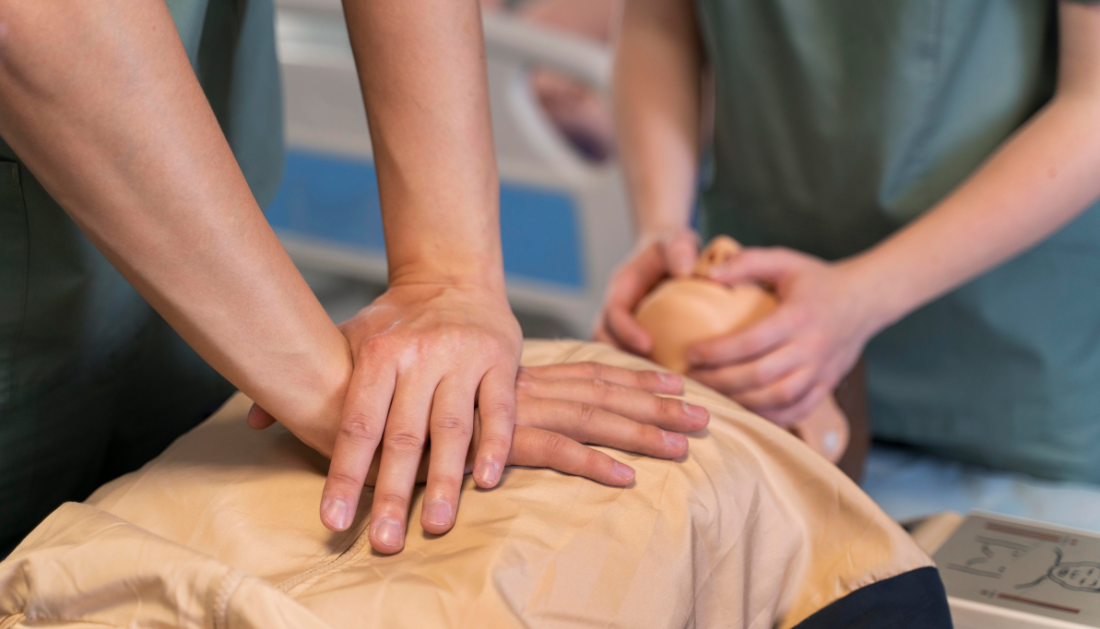
A person’s likelihood of survival while getting cardiopulmonary resuscitation (CPR) for cardiac arrest in a hospital drops significantly from 22% after one minute to fewer than 1% after 39 minutes, according to a US study published in The BMJ.
Similarly, the chances of leaving the hospital with no major brain injury drop from 15% after one minute of CPR to fewer than 1% after 32 minutes of no heartbeat.
According to the researchers, the findings can help medical teams, patients, and their families decide how long to maintain resuscitation.
In-hospital cardiac arrest is a common and severe medical emergency, with only around 25% of patients surviving to be discharged. Studies have revealed that prolonged resuscitation times for patients with in-hospital cardiac arrest are associated with decreased survival rates, but experts have been unable to give definitive recommendations on when to terminate resuscitation.
To fill this knowledge gap, researchers examined the impact of CPR duration (in minutes) on the outcomes of 348,996 US people (average age 67 years) who experienced an in-hospital cardiac arrest between 2000 and 2021. CPR was defined as the time between the commencement of chest compression and the first return of spontaneous circulation (ROSC), or the end of resuscitation.
The primary outcomes of interest were survival to hospital release and favorable functional result at hospital discharge, which was characterized as a brain performance score of 1 (good cerebral performance) or 2 (moderate cerebral disability) on a 5-point scale.
After controlling for potentially influential factors such as age, gender, ethnicity, and a variety of pre-existing conditions, the results show that of the 348,996 patients, 233,551 (67%) achieved spontaneous circulation with an average CPR duration of 7 minutes, while 115,445 (33%) did not achieve spontaneous circulation with an average CPR duration of 20 minutes.
Patients had a 22% chance of surviving and a 15% chance of having a good functional result after just one minute of CPR. However, as the time of CPR grew, the chances of survival and a satisfactory functional result declined to less than 1% at 39 minutes and less than 1% at 32 minutes, respectively.
These are observational observations, and the researchers admit that they made the premise that any cessation of resuscitation was reasonable. They also note that collecting time factors during CPR is difficult, and they were unable to account for the severity of underlying illnesses, as well as the quality of CPR or post-resuscitation care at each institution.
However, they claim that this was a well-designed study using the world’s largest in-hospital cardiac arrest dataset, making the findings relevant for hospitals looking to improve their resuscitation performance.
As a result, they write, “The findings provide resuscitation teams, patients, and their surrogates with insights into the likelihood of favorable outcomes if patients awaiting the first return of spontaneous circulation continue to receive additional cardiopulmonary resuscitation.”
For more information:
Duration of cardiopulmonary resuscitation and outcomes for adults with in-hospital cardiac arrest: retrospective cohort study, The BMJ (2024). DOI: 10.1136/bmj-2023-076019

more recommended stories
 Brain-Computer Interface Uses EEG in Unresponsive Patients
Key findings at a glance Mind-controlled.
 Gamma Oscillations Restored in Alzheimer’s Disease Mice
Key takeaways Researchers restored parvalbumin (PV).
 Coffee Consumption Linked to Lower Recurrent VTE Risk
Key points at a glance Study.
 Body Roundness Index Linked to Higher Heart Attack Risk
Key findings at a glance Study.
 Maternal Diet Fails to Reduce Infant Egg and Peanut Allergy
Key Points A large Australian randomized.
 Visual Impairment Linked to Higher Dementia Risk
Key findings at a glance A.
 Long-Acting HIV Treatment May Help Drug-Resistant Cases
Key Takeaways A UCSF study found.
 Night Shift Work Alters Key Circadian Gene Expression
A recent study published in Frontiers.
 Tirzepatide Weight Loss: Fat Mass and Muscle Findings
Key points Tirzepatide was associated with.
 Coffee and Gut Microbiome: Brewing and Metabolic Effects
Key Points Coffee contains caffeine, chlorogenic.
Leave a Comment