
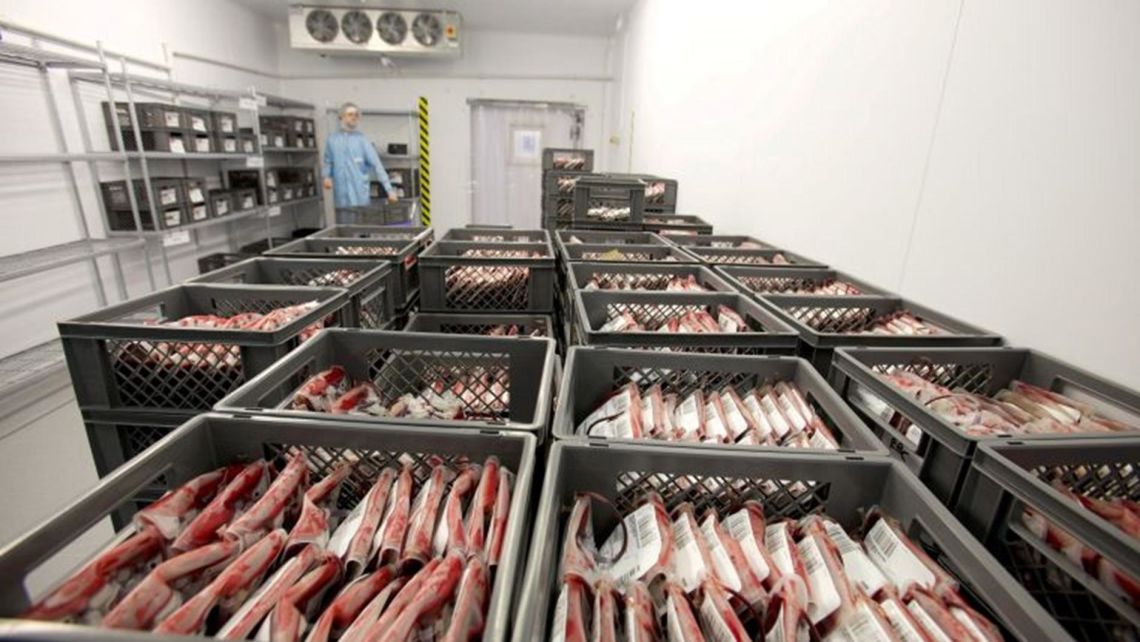
FlowScore (1) – a formula developed at Oxford University in collaboration with NHS Blood and Transplant – predicts how quickly red blood cells release their oxygen. This process is important for oxygenating the body’s tissues, including organs and muscles, particularly in people receiving large transfusions.
Healthy fresh red blood cells have a distinctive biconcave – or dumbbell – shape for efficient oxygen release. During refrigerated storage, red cells become energetically stressed and more spherical, which slows oxygen release. Using transplant kidneys, researchers at Oxford showed that perfusion with blood units that had undergone storage-related kinetic rundown was associated with poorer oxygen delivery, and that this could be restored by biochemically rejuvenating – or refreshing – the blood.
Factors affecting oxygen release from red cells were described at Oxford’s Department of Physiology, Anatomy, and Genetics but the testing method was too laborious for routine use in blood agencies working to improve the monitoring of blood stored for transfusion. To adapt the research findings to blood banking, NHS Blood and Transplant’s Component Development Laboratory joined the project, providing blood samples stored according to NHS protocols and measurements from haematology analysers.
During routine blood counts, haematology analysers use flow cytometry – a method that passes cells through a laser beam to study their characteristics. When light hits a cell, the pattern of scattering reveals information about their size and shape. It was found that this information accurately predicts oxygen release from red blood cells, and the predictive formula was called FlowScore (2)(3). The innovation makes measurements of red cell oxygen transport simpler, faster, and more accessible for laboratories worldwide.
Read the full story on the Department of Physiology, Anatomy and Genetics website.

more recommended stories
 Gamma Oscillations Restored in Alzheimer’s Disease Mice
Key takeaways Researchers restored parvalbumin (PV).
 Coffee Consumption Linked to Lower Recurrent VTE Risk
Key points at a glance Study.
 Body Roundness Index Linked to Higher Heart Attack Risk
Key findings at a glance Study.
 Maternal Diet Fails to Reduce Infant Egg and Peanut Allergy
Key Points A large Australian randomized.
 Visual Impairment Linked to Higher Dementia Risk
Key findings at a glance A.
 Long-Acting HIV Treatment May Help Drug-Resistant Cases
Key Takeaways A UCSF study found.
 Night Shift Work Alters Key Circadian Gene Expression
A recent study published in Frontiers.
 Tirzepatide Weight Loss: Fat Mass and Muscle Findings
Key points Tirzepatide was associated with.
 Coffee and Gut Microbiome: Brewing and Metabolic Effects
Key Points Coffee contains caffeine, chlorogenic.
 Low-Dose Radiation Therapy Shows Promise in Early Knee OA
Key Points Low-dose radiation therapy was.
Leave a Comment