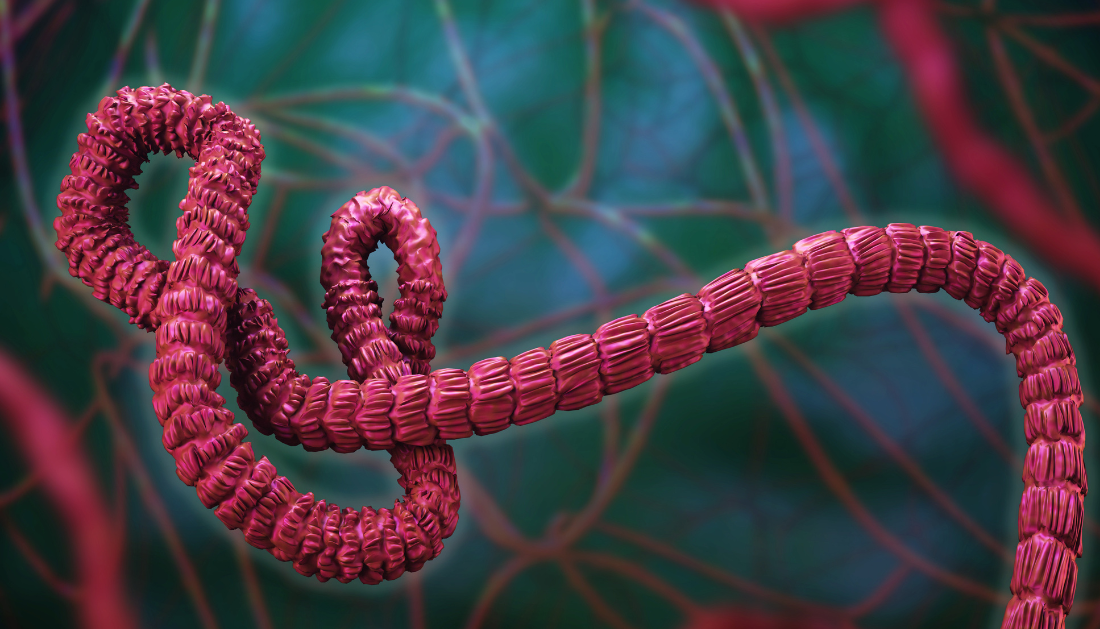
Study: Multiple cell types support productive infection and dynamic translocation of infectious Ebola virus to the surface of human skin

Ebola is a fatal hemorrhagic disease caused by a virus that is found in portions of East-Central and West Africa. Most individuals are aware that the major mode of person-to-person transmission is through contact with an infected person’s bodily fluids. However, more recent outbreaks, such as the 2013-2016 Ebola pandemic in West Africa, have shown that infectious Ebola virus (EBOV) can be discovered on the skin’s surface of persons who have died from infection or at late stages of infection. Although evidence suggests that EBOV can be transmitted by skin contact with a person in the late stages of the disease, nothing is known about how the virus exits the body and reaches the skin’s surface.
In a new study, researchers at the University of Iowa Health Care, along with colleagues at the Texas Biomedical Research Institute and Boston University, traced the virus’s cellular route across the inner and outer layers of skin before emerging onto the skin’s surface. The work finds additional cell types in the skin that EBOV targets during infection and demonstrates that human skin specimens actively promote EBOV infection. Overall, the findings, which were published on January 1 in Science Advances, indicate that the skin’s surface may be one route of person-to-person transfer.
“The skin is the largest organ in the human body yet is woefully understudied compared to most other organs. Interactions of EBOV with skin cells have not previously been extensively examined,” says Wendy Maury, PhD, UI professor of microbiology and immunology, and senior author of the study.
Our work provides evidence for one mechanistic avenue that EBOV uses to exit from the human body. A comprehensive understanding of which cells are targeted during virus infection is critical for rational development of antiviral approaches.”
Wendy Maury, PhD, Professor of Microbiology and Immunology, University of Iowa Health Care
The study team, coordinated by Maury and Kelly Messingham, PhD, UI research professors of dermatology, devised a new method to determine whether cells in the skin are infected with the Ebola virus.They developed a human skin explant system utilizing full-thickness skin biopsies from healthy people, which included both the deeper (dermal) and surface (epidermal) layers of skin.
Previous clinical and animal research had shown that EBOV infects cells within the skin, but the virus’s precise target cells had not been identified.
In the latest study, the researchers discovered that EBOV infected a variety of cell types in the skin explant, including macrophages, endothelial cells, fibroblasts, and keratinocytes. While several of these cell types have been reported to be infected with EBOV in other organs, keratinocytes, which are specific to the skin, were not previously recognized as supporting EBOV infection.
Interestingly, viral replication was more robust in the epidermal layer than in the dermal layers per gram. Furthermore, the infectious virus was found on the epidermal surface within three days, demonstrating that the virus spreads quickly and goes from the explants to the skin’s surface.
The researchers also demonstrated that human skin explants may be used as complex, three-dimensional organ models to examine the efficiency of antivirals against EBOV, creating a new, highly useful, and cost-effective model system for therapeutic testing.
Finally, the scientists investigated how EBOV interacts with two types of skin cells, fibroblasts and keratinocytes, and discovered unique receptors on these cells that allow Ebola virus uptake.
“This study explores the role of the skin as a potential route of Ebola virus infection and identifies, for the first time, several cell types in the skin that are permissive to infection,” says Messingham. “In total, these findings elucidate a mechanism by which EBOV traffics to the skin’s surface and may explain person-to-person transmission via skin contact.”
For more information: Messingham, K. N., et al. (2025). Multiple cell types support productive infection and dynamic translocation of infectious Ebola virus to the surface of human skin. Science Advances. doi.org/10.1126/sciadv.adr6140.

 Visual Impairment Linked to Higher Dementia Risk
Key findings at a glance A.
 Long-Acting HIV Treatment May Help Drug-Resistant Cases
Key Takeaways A UCSF study found.
 Night Shift Work Alters Key Circadian Gene Expression
A recent study published in Frontiers.
 Tirzepatide Weight Loss: Fat Mass and Muscle Findings
Key points Tirzepatide was associated with.
 Coffee and Gut Microbiome: Brewing and Metabolic Effects
Key Points Coffee contains caffeine, chlorogenic.
 Low-Dose Radiation Therapy Shows Promise in Early Knee OA
Key Points Low-dose radiation therapy was.
 Oral Hormone Replacement Therapy Raises Blood Clot Risk
Key Points Oral hormone replacement therapy.
 GLP-1 Health Information: Quality, Completeness, & Engagement
Key Points A study assessed 128.
 DNA Damage Response May Drive Biological Aging
Key Points Chronic DNA damage response.
 Maternal Diet Fails to Reduce Infant Egg and Peanut Allergy
Key Points A large Australian randomized.
Leave a Comment