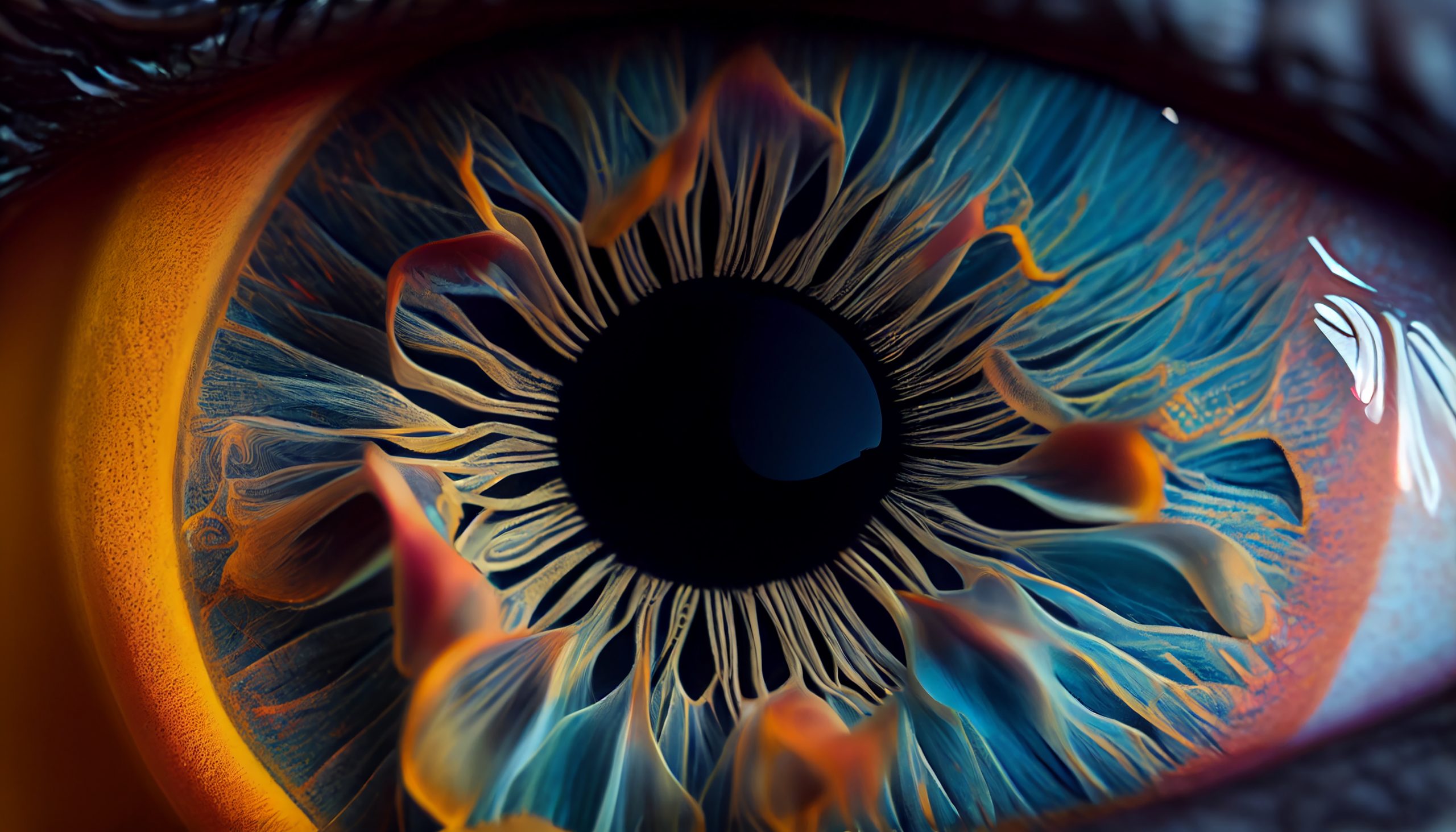
Image by vecstock on Freepik

According to new research, many visual illusions are generated by limitations in the way our eyes and visual neurons work, rather than more complicated psychological processes.
Researchers investigated illusions in which an object’s surrounds influence how we perceive its color or pattern. The paper was published in the journal PLOS Computational Biology and is titled “A model of color appearance based on efficient coding of natural images.”
Scientists and philosophers have long argued whether optical illusions are created by neuronal processing in the eye and low-level visual centers in the brain, or by higher-level mental processes such as context and prior knowledge.
In the new study, Dr. Jolyon Troscianko of the University of Exeter co-developed a model that shows simple constraints to brain responses, rather than deeper psychological processes, explain these illusions.
“Our eyes send messages to the brain by making neurons fire faster or slower,” said Dr. Troscianko, from the Center for Ecology and Conservation on Exeter’s Penryn Campus in Cornwall. “However, there’s a limit to how quickly they can fire, and previous research hasn’t considered how the limit might affect the ways we see color.”
This “limited bandwidth” is combined with information on how people see patterns at different scales, as well as the idea that our eyesight operates best when we are gazing at natural scenes.
Researchers from the Universities of Exeter and Sussex created the model to predict how animals sense color, but it was discovered to correctly anticipate many visual illusions seen by people as well.
“This throws into the air a lot of long-held assumptions about how visual illusions work,” Dr. Troscianko said.
According to him, the data shed insight on the appeal of high-definition televisions.
“Modern high dynamic range televisions create bright white regions that are over 10,000 times brighter than their darkest black, approaching the contrast levels of natural scenes,” Dr. Troscianko added.
“How our eyes and brains can handle this contrast is a puzzle because tests show that the highest contrasts we humans can see at a single spatial scale is around 200:1.
Even more confusingly, the neurons connecting our eyes to our brains can only handle contrasts of about 10:1.
“Our model shows how neurons with such limited contrast bandwidth can combine their signals to allow us to see these enormous contrasts, but the information is ‘compressed’—resulting in visual illusions.
“The model shows how our neurons are precisely evolved to use of every bit of capacity.
“For example, some neurons are sensitive to very tiny differences in gray levels at medium-sized scales, but are easily overwhelmed by high contrasts.
“Meanwhile, neurons coding for contrasts at larger or smaller scales are much less sensitive, but can work over a much wider range of contrasts, giving deep black-and-white differences.
“Ultimately this shows how a system with a severely limited neural bandwidth and sensitivity can perceive contrasts larger than 10,000:1.”

 Brain-Computer Interface Uses EEG in Unresponsive Patients
Key findings at a glance Mind-controlled.
 Gamma Oscillations Restored in Alzheimer’s Disease Mice
Key takeaways Researchers restored parvalbumin (PV).
 Coffee Consumption Linked to Lower Recurrent VTE Risk
Key points at a glance Study.
 Body Roundness Index Linked to Higher Heart Attack Risk
Key findings at a glance Study.
 Maternal Diet Fails to Reduce Infant Egg and Peanut Allergy
Key Points A large Australian randomized.
 Visual Impairment Linked to Higher Dementia Risk
Key findings at a glance A.
 Long-Acting HIV Treatment May Help Drug-Resistant Cases
Key Takeaways A UCSF study found.
 Night Shift Work Alters Key Circadian Gene Expression
A recent study published in Frontiers.
 Tirzepatide Weight Loss: Fat Mass and Muscle Findings
Key points Tirzepatide was associated with.
 Coffee and Gut Microbiome: Brewing and Metabolic Effects
Key Points Coffee contains caffeine, chlorogenic.
Leave a Comment