
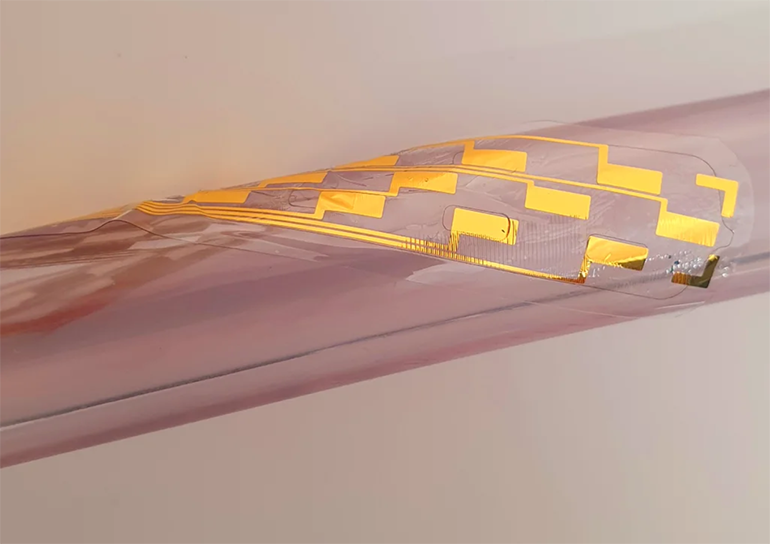
Researchers at the University of Cambridge created a spinal stimulation device that can help to control severe pain. Unlike existing technologies, which require invasive surgery for implantation, the new device can be delivered using a needle. Once implanted, the device unfurls and inflates to provide extensive coverage during spinal cord stimulation to control severe pain. The technology could make spinal cord stimulation more accessible for millions of chronic pain sufferers.
For many patients, chronic pain does not respond to conventional treatments and can be severe and debilitating. For such individuals, spinal cord stimulation may be an option, whereby electricity is used to disrupt pain signals in the spine. However, installing the most effective type of spinal stimulation devices is invasive, requiring complex surgery under general anesthesia, and many patients are poor candidates for such treatment.
“Spinal cord stimulation is a treatment of last resort, for those whose pain has become so severe that it prevents them from carrying out everyday activities,” said Damiano Barone, a researcher involved in the study, via a University of Cambridge announcement. “However, the two main types of spinal cord stimulation devices both have flaws, which may be one reason their use is limited, even though millions struggle with chronic pain every day.”
This latest technology aims to combine minimally invasive delivery with extensive spinal coverage and efficacy in pain relief. “Our goal was to make something that’s the best of both worlds – a device that’s clinically effective, but that doesn’t require complex and risky surgery,” said Christopher Proctor, another researcher involved in the study. “This could help bring this life-changing treatment option to many more people.”

The device is an ultrathin pouch rolled into a tiny cylinder that can fit into a needle. Once delivered into the epidural space, the pouch unrolls and can be inflated using water or air to cover an area of the spinal cord. Tiny electrodes within the inflated structure can then deliver electrical current to the spinal cord, helping to disrupt pain signals.
“The way we make the device means that we can also incorporate additional components – we could add more electrodes or make it bigger to cover larger areas of the spine with increased accuracy,” said Barone. “This adaptability could make our spinal cord stimulation device a potential treatment for paralysis following spinal cord injury, stroke or movement disorders such as Parkinson’s disease. In addition, an effective device that doesn’t require invasive surgery could bring relief to so many people.”
Here’s a video demonstrating the new device expanding:

more recommended stories
 Visual Impairment Linked to Higher Dementia Risk
Key findings at a glance A.
 Long-Acting HIV Treatment May Help Drug-Resistant Cases
Key Takeaways A UCSF study found.
 Night Shift Work Alters Key Circadian Gene Expression
A recent study published in Frontiers.
 Tirzepatide Weight Loss: Fat Mass and Muscle Findings
Key points Tirzepatide was associated with.
 Coffee and Gut Microbiome: Brewing and Metabolic Effects
Key Points Coffee contains caffeine, chlorogenic.
 Low-Dose Radiation Therapy Shows Promise in Early Knee OA
Key Points Low-dose radiation therapy was.
 Oral Hormone Replacement Therapy Raises Blood Clot Risk
Key Points Oral hormone replacement therapy.
 GLP-1 Health Information: Quality, Completeness, & Engagement
Key Points A study assessed 128.
 DNA Damage Response May Drive Biological Aging
Key Points Chronic DNA damage response.
 Maternal Diet Fails to Reduce Infant Egg and Peanut Allergy
Key Points A large Australian randomized.
Leave a Comment