
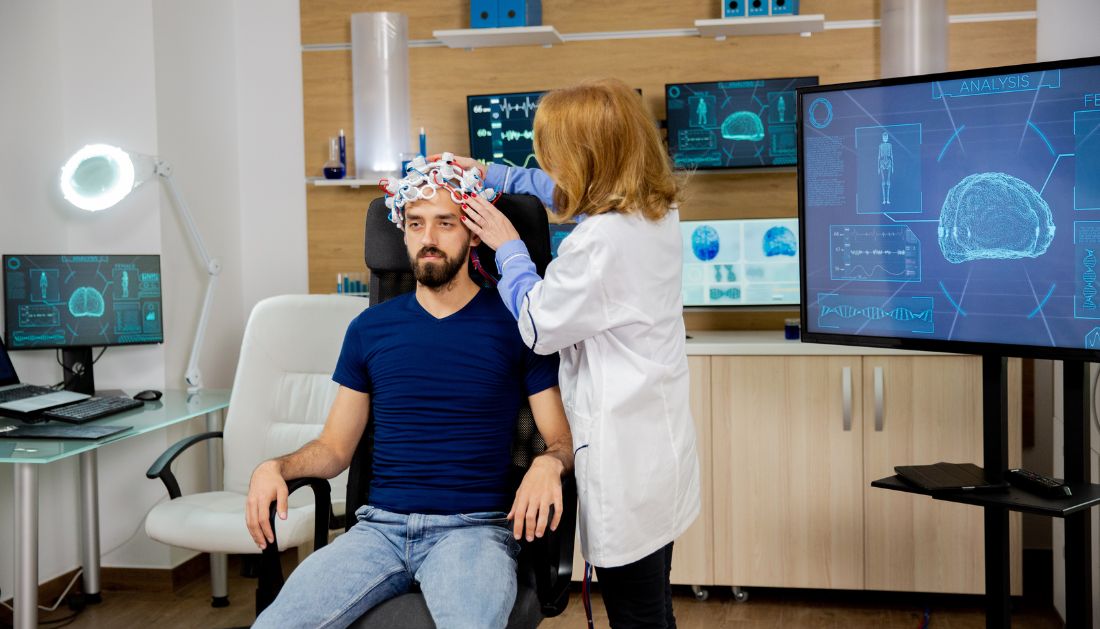
A new clinical study led by the University of Calgary has revealed that transcranial magnetic stimulation (TMS), when paired with intensive speech therapy, TMS for Post-Stroke Aphasia enhances language recovery in stroke survivors, even years after the initial stroke event.
Understanding Aphasia and the Need for Innovative Therapies
Aphasia is a neurological condition that impairs a person’s ability to speak, understand language, read, or write. It commonly occurs after a stroke or brain injury, making communication a daily challenge for survivors. Traditional speech therapy has long been the cornerstone of rehabilitation, but for patients like Lucy Mulloor, who lived with aphasia for three years post-stroke, progress can be slow and unpredictable.
Mulloor, a 45-year-old mother of two, suffered a major stroke during the night. She awoke to find herself unable to speak or move the right side of her body. After a prolonged hospital stay, she was left with aphasia and limited mobility—conditions she believed might never improve. Then came an opportunity to participate in a groundbreaking clinical trial.
TMS for Post-Stroke Aphasia: A Non-Invasive Breakthrough
Dr. Sean Dukelow, principal investigator and professor at the Cumming School of Medicine, initiated a double-blind, sham-controlled randomized trial to examine the effects of TMS for post-stroke aphasia. The goal was to explore whether the brain could still recover linguistic function long after the typical rehabilitation window had passed.
The study included 44 participants, each at least six months post-stroke. While all received two weeks of intensive speech therapy, only half received active TMS. The others underwent a “sham” stimulation that mimicked the experience but without actual brain stimulation.
Following stimulation, participants engaged in over three hours daily of multimodal aphasia therapy (M-MAT)—a combination of reading, writing, drawing, and speech drills designed to stimulate different areas of the brain.
Encouraging Results from TMS and Speech Therapy Integration
The results were promising: both groups showed speech improvements, but the TMS group achieved significantly greater gains. Participants reported better word recall, sentence formation, and even improved mood and physical movement. Importantly, these benefits were observed in individuals who had suffered strokes several years earlier—challenging the notion that brain plasticity diminishes over time.
Shannan Love, the lead speech-language pathologist on the trial, noted, “Seeing functional improvements was incredible. Even without knowing who received real TMS, the progress was evident.”
Redefining Stroke Recovery Timelines
Dr. Dukelow emphasized that this study shifts the narrative around stroke recovery. “This research proves that with the right combination of therapies, the brain can continue to adapt and improve well beyond the acute phase of recovery.”
For patients and providers alike, the combination of TMS for post-stroke aphasia and structured speech therapy offers a new beacon of hope—one that’s non-invasive, effective, and supported by emerging science.
For more information: Low, T. A., Lindland, K., Kirton, A., Carlson, H. L., Harris, A. D., Goodyear, B. G., Monchi, O., Hill, M. D., Rose, M. L., & Dukelow, S. P. (2025). Transcranial Magnetic Stimulation Combined With Multimodality Aphasia Therapy for Chronic Poststroke Aphasia. Neurology, 104(6). https://doi.org/10.1212/wnl.0000000000213424

more recommended stories
 Brain-Computer Interface Uses EEG in Unresponsive Patients
Key findings at a glance Mind-controlled.
 Gamma Oscillations Restored in Alzheimer’s Disease Mice
Key takeaways Researchers restored parvalbumin (PV).
 Coffee Consumption Linked to Lower Recurrent VTE Risk
Key points at a glance Study.
 Body Roundness Index Linked to Higher Heart Attack Risk
Key findings at a glance Study.
 Maternal Diet Fails to Reduce Infant Egg and Peanut Allergy
Key Points A large Australian randomized.
 Visual Impairment Linked to Higher Dementia Risk
Key findings at a glance A.
 Long-Acting HIV Treatment May Help Drug-Resistant Cases
Key Takeaways A UCSF study found.
 Night Shift Work Alters Key Circadian Gene Expression
A recent study published in Frontiers.
 Tirzepatide Weight Loss: Fat Mass and Muscle Findings
Key points Tirzepatide was associated with.
 Coffee and Gut Microbiome: Brewing and Metabolic Effects
Key Points Coffee contains caffeine, chlorogenic.
Leave a Comment