
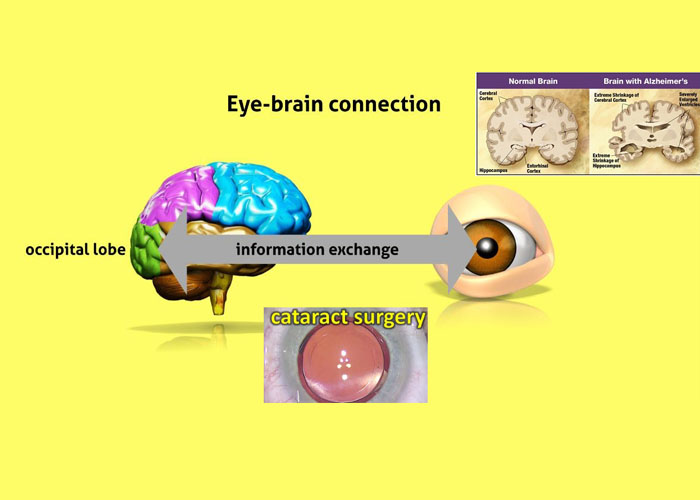
People with newly diagnosed Alzheimer’s disease less likely to have cataract surgery than unaffected people.
The prevalence of Alzheimer’s disease (AD) has increased globally during the last decades. It is well known that suboptimal care of comorbidities can accelerate the course of cognitive decline in AD.
One of these comorbidities, poor vision, is associated with cognitive decline. The most common cause of poor vision and vision loss is cataract, where the opacity of the crystalline lens of the eye is lost. The only Alzheimer’s Disease treatment is rather mini-invasive surgery.
People with Alzheimer’s disease (AD) are less likely to have cataract surgery than people without Alzheimer’s disease. The procedure rate starts to decrease already one year after the diagnosis, according to a new study from the University of Eastern Finland.
The lower likelihood of cataract surgery among people with cognitive disorders has been reported previously. This study is the first to report an association between the AD diagnosis and a lower incidence of cataract surgery, and a decrease in the procedure rate related to the time since the diagnosis.
The decrease in the incidence of cataract surgery among people with newly diagnosed AD is concerning because the benefits of this low-risk procedure would probably be similar for people with and without AD.
“The results of the study indicate that people with AD might have a higher threshold for cataract procedures. However, persons with cognitive disorders should be actively referred to ophthalmologic consultations because cataract surgery can improve their cognitive and physical functioning. The stigma of the disease should not lead to fewer referrals to cataract surgery,” the authors say.
The study was conducted as part of the Medication Use and Alzheimer’s Disease Study (MEDALZ), in a cohort which includes 70,718 Finnish community dwellers with AD diagnosed between years 2005 and 2011. They were compared to persons of the same age and gender without AD.

more recommended stories
 Gamma Oscillations Restored in Alzheimer’s Disease Mice
Key takeaways Researchers restored parvalbumin (PV).
 Long-Acting HIV Treatment May Help Drug-Resistant Cases
Key Takeaways A UCSF study found.
 Coffee and Gut Microbiome: Brewing and Metabolic Effects
Key Points Coffee contains caffeine, chlorogenic.
 Low-Dose Radiation Therapy Shows Promise in Early Knee OA
Key Points Low-dose radiation therapy was.
 GLP-1 Health Information: Quality, Completeness, & Engagement
Key Points A study assessed 128.
 DNA Damage Response May Drive Biological Aging
Key Points Chronic DNA damage response.
 Psychedelic-Assisted Psychotherapy: Music in Treatment
Key Takeaways Psychedelic-assisted psychotherapy combines psychedelic.
 Cardiovascular Frailty Links Heart Health and Aging
Key Points Cardiovascular frailty may connect.
 Laser Blended Vision: Simple Test Predicts Success
Key Points A simple phoropter-based test.
 Rett Syndrome: Carotid Body Linked to Breathing Dysfunction
Key Points Rett syndrome is associated.
Leave a Comment