
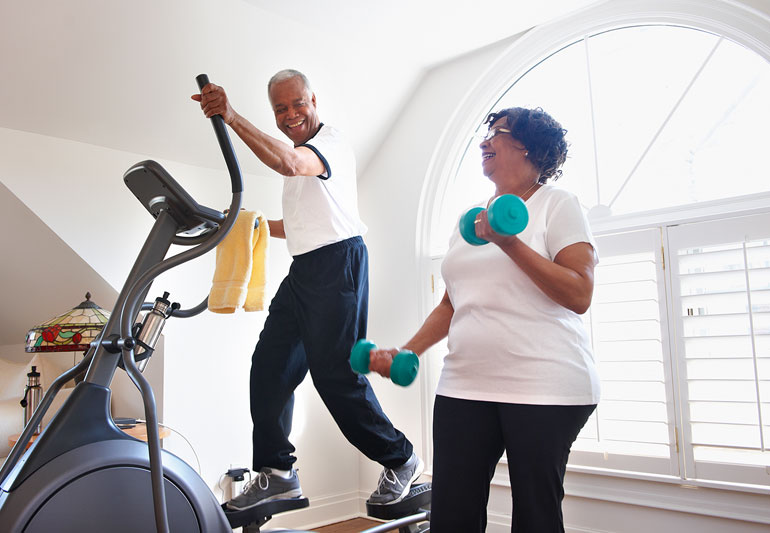
Hip and knee replacements can get you back to an active life in no time. Know this, though: You are an important factor in determining the ultimate outcome of the surgery. A new hip or knee joint doesn’t work by itself.
Getting the most out of your new parts requires a commitment to an exercise program. That work begins immediately after surgery with a personalized rehabilitation plan created by a physical therapist.
But a critical part of the recovery process begins after the last physical therapy appointment ends. “You are already engaged in an exercise program,” says physical therapist Michele Hribar, PT. “Now you need to continue it for the rest of your life.”
The importance of exercise after joint replacement surgery
Building up muscles around your new hip or knee is a must to keep the joint in tip-top shape. Hribar recommends continuing the targeted exercise routine you’ve already established with your physical therapist.
“You really have to optimize exercises to strengthen those supporting muscles,” says Hribar.
Overall physical fitness is also important — especially because knee or hip pain before surgery may have prevented you from getting enough activity. This may have caused weakness or limitations in areas other than the affected joint.
“Now that the joint is in better shape, you have the opportunity to enhance and maintain overall physical fitness,” says Hribar.
Exercise also is needed for balance, which can be affected after surgery.
The best exercises after joint replacement
Your workout routine should be a combination of aerobic activity and exercises for strength, flexibility and balance. Just a walking or bicycling program isn’t enough because neither target the muscles you need for mobility and balance.
Some good news, too: When you put that new hip or knee to work, activities may seem easier to do. “After surgery, these exercises should be better tolerated because of the pain relief from the new joint,” says Hribar.
Here are recommendations to break a sweat in two categories:
Aerobic activities
Aerobic activities get your heart beating faster. To get the ticker pumping, try walking, bicycling or using an elliptical machine. For variety, alternate between the different activities. Consider using trekking poles for outdoor walking if you’re having difficulty with balance and stability.
Once you’re fully recovered from your joint replacement, you should be able to do just about any activity you did before surgery. However, most surgeons don’t recommend running.
Before giving up any activity you enjoy, Hribar suggests talking to your doctor or physical therapist. You may be able to go back to some higher impact activities or find ways to modify them.
“We’re able to get people back to playing pickleball or doubles tennis, although singles tennis is more challenging,” says Hribar.
As a target, try to reach at least 30 minutes of aerobic activity most days of the week.
Exercises for strength, flexibility and balance
Muscle mass and bone density naturally decline with age. To slow that process down, it’s important to have a comprehensive exercise routine.
Strengthening exercises following a hip or knee replacement should include ones that target the quadriceps (four muscles in the front of the thigh), gluteals (three muscles that make up the buttocks) and hip abductors (muscles responsible for moving your thigh out to the side).
Look to do focused strength and balance exercises two to three times a week. To build and maintain flexibility, exercises such as hamstring stretches and heel cord stretches should become part of your daily routine.
Find the joy in exercise
Hribar notes that there are activities that combine aerobics, balance, strengthening and flexibility. Examples are dancing, yoga, tai chi and pool exercises — all of which can be social, too, with in-person classes opening up once again after the pandemic and online options also available.
“You can make it fun,” says Hribar.

more recommended stories
 Gamma Oscillations Restored in Alzheimer’s Disease Mice
Key takeaways Researchers restored parvalbumin (PV).
 Long-Acting HIV Treatment May Help Drug-Resistant Cases
Key Takeaways A UCSF study found.
 Coffee and Gut Microbiome: Brewing and Metabolic Effects
Key Points Coffee contains caffeine, chlorogenic.
 Low-Dose Radiation Therapy Shows Promise in Early Knee OA
Key Points Low-dose radiation therapy was.
 GLP-1 Health Information: Quality, Completeness, & Engagement
Key Points A study assessed 128.
 DNA Damage Response May Drive Biological Aging
Key Points Chronic DNA damage response.
 Psychedelic-Assisted Psychotherapy: Music in Treatment
Key Takeaways Psychedelic-assisted psychotherapy combines psychedelic.
 Cardiovascular Frailty Links Heart Health and Aging
Key Points Cardiovascular frailty may connect.
 Laser Blended Vision: Simple Test Predicts Success
Key Points A simple phoropter-based test.
 Rett Syndrome: Carotid Body Linked to Breathing Dysfunction
Key Points Rett syndrome is associated.
Leave a Comment